| |
A
Brief Review of Past Events (1998-2007)
|
|
1998
|
Our
activities in 1998 consisted of a concert featuring a Tsugaru
Shamisen performer from Japan, and a 2-day matsuri in the mall
area of the Factoria Shopping Center. The matsuri featured stage
performances, martial arts demonstrations, and exhibits.
|
|
|
1999
|
1999
activities included a concert featuring a World-renowned shakuhachi
performer from Japan and an accompanying guitarist at the Meydenbauer
Center, a book reading and panel discussion at the Redmond Town
Center's Barnes & Noble Bookstore, and a 2-day matsuri again
at Factoria Shopping Center mall with a program similar to the
one in 1998.
|
|
|
2000
|
In
2000 we presented a 2-day matsuri featuring guest artists from
Japan along with a multitude of local area performers and artisans.
However, we focused our attentions on a new venue moving to
the Bellevue Community College Campus. The expanded program
included on-stage performing artists, martial arts demonstrations,
exhibits, Japanese Style food cooking demonstrations, and food
booths (Yatai). A Japanese demonstration teahouse measuring
17 feet x 17 feet were erected with tea ceremony demonstrations
and tea sampling.
|
|
|
2001
|
In
2001 we returned to the Bellevue Community College campus with
a karaoke competition, concert, and 2-day matsuri with a program
similar to the popular 2001 Program. Event attendance was approximately
3,000.
|
|
|
2002
|
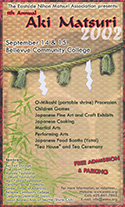
The
2002 Program featured martial arts demonstrations, performing
arts performances and workshops, cultural art & craft exhibits,
demonstrations and workshops; Japanese food cooking demonstrations
and food stalls, a Japanese demonstration teahouse measuring
17 feet x 17 feet were erected with tea ceremony demonstrations
and tea sampling. And a special feature this year was the display
and parading of a mikoshi (portable Shinto Shrine from the Tsubaki
Grand Shrine of America located in Granite Falls, WA). An estimated
5,000 attended.
And, in 2002 we also presented a shakuhachi concert and workshop
by world-renowned artist from Japan (John Kaizan Neptune). The
concert had an audience of 250, and the workshop 20.
|
|
|
2003
|
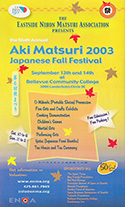
2003
was an expanded 2002 Program with the addition of a special
"Dress of Japan" segment with beautiful kimono for
many occasions worn/modeled by men and women, and an educational
Rice Project showing the parallel & differences in Japan
and America of rice cultivation, the societal implications,
the many uses in food and other items. The crowds for this 2-day
event were estimated to be approximately 6,000.
|
|
|
2004
|
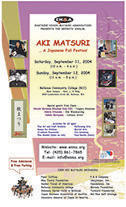
2004 set yet more records with a significantly increased attendance,
and expanded activities. The overall program of martial arts,
culinary arts, fine arts & crafts, and performing arts was
augmented with the addition of a Nomi-no-ichi (flea market),
a Master Tsugaru shamisen artist from Aomori, Japan, a Edo-style
woodcarver from Tokyo. The attendance for this 2-day event was
estimated to be 7,000 ~ 7,500.
|
|
|
2005
|
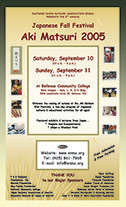
2005 attendance was estimated to be about the same as 2004;
a considerable success considering the inclement weather. The
core programs again included the martial arts, culinary art,
fine art & craft exhibits & demonstrations, and performing
arts. Japan Guest art & artists included Tsugaru Nuri (lacquer)
from Hirosaki - ken, Japan and Ukiyo-e (woodblock) printing
demonstrations by members of the Adachi Institute of Woodcut
Print, Tokyo, Japan (partially supported by the Japan Foundation).
Special Projects included taiko workshops, bonsai workshops,
Japan Culture in Classroom workshop, Nomi-no-ichi (flea market)
as in 2004.
|
|
|
2006
|
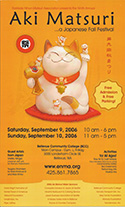
2006 attendance increased to an estimated 9,000 ~ 9,500 visitors.
Core programs of martial arts, fine art & craft, and performing
arts were similar in scope and size to 2005. Japan Guest art
& artists were a return visit of a Master Tsugaru shamisen
artist and his accompanying student from Aomori, Japan, and
Sosaku Ningyo artist from Saitama ken. The Tsugaru Shamisen
artists visited Renton and Mountainview (Auburn) High Schools
to give presentations to approximately 400 students and faculty
following the matsuri, and the Sosaku Ningyo artist exhibited
and gave workshops at the Seattle Asian Art Museum and the Rosalie
Whyel Museum of Doll Art during the week following the matsuri.
|
|
|
2007
|
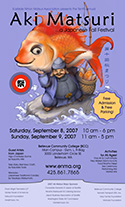
2007 attendance increased to an estimated 10,000 matsuri visitors,
and we were favored by beautiful weather. Core programs of martial
arts, fine art & craft, and performing arts were similar
in scope and size to 2006. Featured Guest arts & artists
from Japan included a) Wa-rosoku (Japanese Candles) by Yasukazu
Matsumoto from Nishinomiya-shi, Hyogo-ken, b) Take Zaiku (Bamboo
craft) by Kazutaka Toda from Miki-shi, Hyogo-ken, c) Higo Chonkake
Goma (an intangible folk cultural asset of Kumamoto) by Kazuhito
Miki from Itami-shi, Hyogo-ken, and d) 100 Shrine Forest Exhibit
of paintings and photographs of Ichinomiya (original No. 1 shrines)
by Yukihiro Sekiguchi and Noburo Yonezawa of Ichinomiya Junpai
Kai of the Kansai Region of Japan. Toda-san also gave a 2 hour
workshop to the Northwest Basket Weavers Guild at their monthly
meeting. Toda-san, Matsumoto-san and Miki-san traveled to Spokane
to present workshops and demonstrations for the Mukogawa Fort
Wright Institute / Japan Community Center.
|
|
| |
|
|
|